- 937 Fir Street #100, Sherwood Park, AB T8A 4N6
- Mon–Fri 9:00 AM – 7:00 PM
- (587) 200-4874
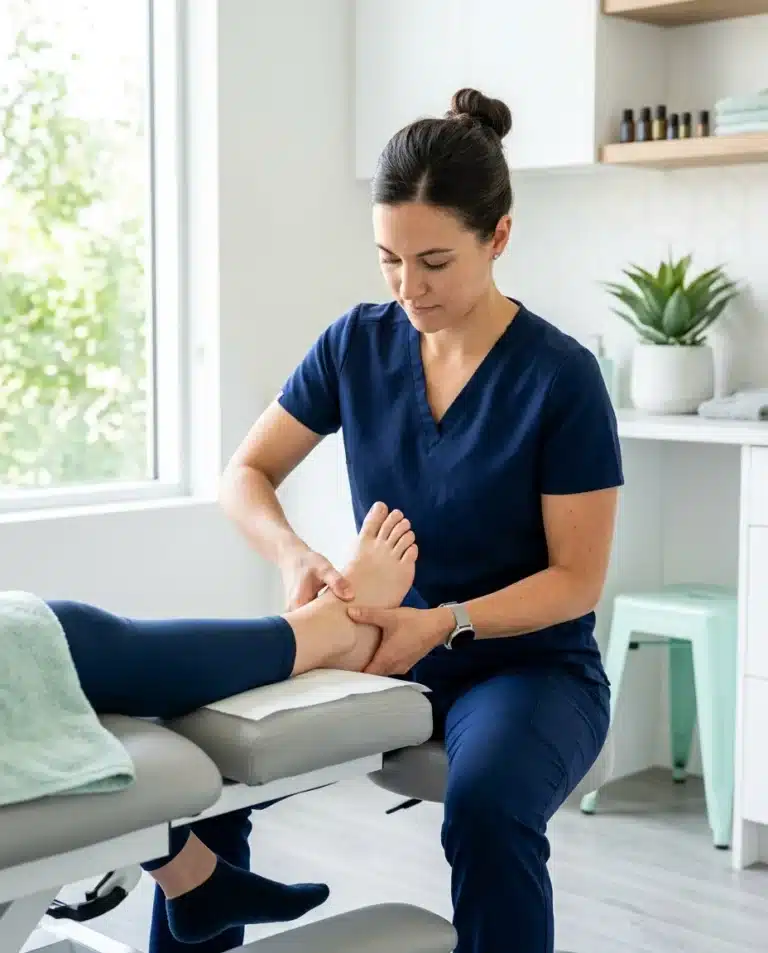
Custom Orthotics Sherwood Park at Eastgate are made from a physiotherapist’s assessment of how you stand, walk and load your feet, then fitted and adjusted to your footwear. They help with plantar fasciitis, flat feet, heel and arch pain, and knee or hip pain linked to foot mechanics. Many extended health plans cover custom orthotics when prescribed.
Schedule your appointment in minutes
One-on-one treatment tailored to your needs.
Evidence-based care to help you return stronger
Book An Appointment
Home / Services / Custom Orthotics
People with heel or arch pain, flat or high-arched feet, shin splints, knee pain related to foot posture, and workers who stand all day. Orthotics are one part of the plan — we pair them with exercise so the improvement lasts.
Plantar fasciitis Achilles tendinopathy Shin splints Knee & ACL injuries Hip pain Extended health benefits Self-pay fees
Call us any time
(587) 200-4874
Related conditions: Plantar fasciitis · Achilles tendinopathy · Shin splints · Knee & ACL injuries · Hip pain
Funding options: Extended health benefits · Self-pay fees
Eastgate Physiotherapy has served Sherwood Park for over 35 years. No referral is needed, same-day appointments are available most days, and we direct-bill most extended health plans, WCB and motor vehicle accident (MVA) claims. Call (587) 200-4874 or book online to get started.

Custom Orthotics rarely exists in isolation. The links below cover the treatments we combine, the related conditions we see alongside it, and how each is funded, so you can see the full picture of your care at Eastgate.
Learn how Plantar fasciitis fits into your plan at Eastgate Physiotherapy. Read more about Plantar fasciitis →
Learn how Achilles tendinopathy fits into your plan at Eastgate Physiotherapy. Read more about Achilles tendinopathy →
Learn how Shin splints fits into your plan at Eastgate Physiotherapy. Read more about Shin splints →
Learn how Knee & ACL injuries fits into your plan at Eastgate Physiotherapy. Read more about Knee & ACL injuries →
Learn how Hip pain fits into your plan at Eastgate Physiotherapy. Read more about Hip pain →
Learn how Extended health benefits fits into your plan at Eastgate Physiotherapy. Read more about Extended health benefits →
Learn how Self-pay fees fits into your plan at Eastgate Physiotherapy. Read more about Self-pay fees →
Early assessment usually means a shorter course of treatment. If you are unsure which service you need, call the clinic and we will point you to the right practitioner.
At Eastgate Physiotherapy we combine hands-on techniques, guided exercise and education so that every Custom Orthotics Sherwood Park plan is built around your goals. Treatment starts on your first visit, and progress is measured at every appointment so you always know where you stand.
Your first visit is a detailed evaluation of your history, movement and the demands of your work and sport. We explain what we find in plain language and agree a plan together.
Manual therapy, joint mobilisation and soft-tissue techniques to reduce pain and restore movement, chosen for your specific findings.
A progressive program matched to your stage of recovery, taught in the clinic and given to you to continue at home.
Dry needling, taping and other modalities are added when they will speed your progress, never as a substitute for active care.
Understanding your condition, what aggravates it and how to pace activity is part of every plan.
Milestones and testing guide a safe, gradual return so you can be confident the improvement will last.
Progress is re-measured at each visit and your plan adjusted; we coordinate with your physician or insurer when needed.
Our goal at Eastgate Physiotherapy is to support each patient’s confident recovery through evidence-based Custom Orthotics. Our registered practitioners take time to understand your situation, communicate clearly, and build a plan you can actually follow. With more than 35 years in Sherwood Park, we know the community and the demands of the work and sport our patients return to.
A structured Custom Orthotics program offers physical, functional and practical benefits: reduced pain, restored movement and strength, a faster and safer return to normal activity, and a lower chance of the problem coming back. Just as important, you understand what happened and how to manage it yourself.
To make sure you get the care you need without financial strain, Eastgate Physiotherapy works with all major insurers, WCB Alberta and motor vehicle accident (MVA) claims. In most cases there is no upfront cost for custom orthotics care.
Most extended health plans cover physiotherapy, massage and acupuncture; we direct-bill Alberta Blue Cross, Sun Life, Manulife, Canada Life, GreenShield and more.

If your injury happened at work, WCB Alberta typically covers assessment, treatment and reporting at no cost to you; we complete the forms.
After a car accident, Section B benefits cover treatment regardless of fault with no upfront cost; we submit the AB-1 and treatment plan.
No coverage? Transparent self-pay fees with itemised receipts for tax or later submission.
Our front desk can check your coverage before your first visit, submit claims on your behalf and coordinate benefits between two plans. See our funding and direct billing pages for details.
Every recovery is different. Our physiotherapists set clear goals with you at the first visit, measure progress at each appointment and adjust the plan as you improve. Whether you are returning to a physical job, a sport or simply daily life without pain, Custom Orthotics Sherwood Park at Eastgate is built around what you need to get back to.
Through Custom Orthotics Sherwood Park at Eastgate Physiotherapy in Sherwood Park, our team helps you regain strength, restore function and return to your work and activities with confidence. Call (587) 200-4874 or book online to start.
Satish Pandya is a Registered Physiotherapist and the clinical lead at Eastgate. His approach starts with a thorough assessment and a plain-language explanation of what is driving your symptoms, followed by a plan built around your goals. He uses IMS, manual therapy and progressive exercise as the core of most treatment plans.
Many plans do, often requiring a prescription and a gait assessment report. We provide the documentation your insurer asks for.
Typically two to five years depending on use and footwear.
Most people move one pair between shoes; a second pair is useful for work boots or sport-specific footwear.
People with heel or arch pain, flat or high-arched feet, shin splints, knee pain related to foot posture, and workers who stand all day. Orthotics are one part of the plan — we pair them with exercise so the improvement lasts.
Assessment includes a gait analysis and foot examination, then a cast or scan of your feet. The orthotics are manufactured to that mould and fitted in a follow-up visit, with adjustments included.
No. Physiotherapy, massage and acupuncture in Alberta are direct-access services. Some insurers ask for a physician referral to reimburse, so check your plan.
Yes. We bill Alberta Blue Cross, Sun Life, Canada Life, Manulife, GreenShield and most other plans directly, as well as WCB and motor vehicle claims.
About 60 minutes for a full assessment and, in most cases, the start of treatment the same day.
Your insurance card, any imaging or reports, comfortable clothing, and a claim number if this is a WCB or car accident case.
Most days, yes. Call before noon and we can usually fit you in.
937 Fir Street #100, Sherwood Park, just off Baseline Road and Sherwood Drive, with free parking at the door.
Monday to Friday, 9:00 AM to 7:00 PM.
Yes. Request a practitioner by name when you book.
Yes. Our physiotherapists treat patients of all ages.
We ask for 24 hours’ notice so the time can be offered to another patient.
Reviews are published by patients on Google and shown unedited. Eastgate’s physiotherapists are registered physiotherapists, not physicians.
Excellent rating
Based on 84 reviews

Trustindex verifies that the original source of the review is Google.
Satish has helped me with numerous issues including a needle-stick injury, a back issue and sciatica. He is an expert in his field who is willing to share his knowledge. His treatments are effective, safe and he has been able to restore my movement every time I have been under his care. I highly recommend Satish for your physiotherapy needs. Shaunna BradshawI had an excellent experience at East Gate Physiotherapy in Sherwood Park. Satish was incredibly knowledgeable, professional, and genuinely caring. He took the time to understand the source of my intense pain and explained everything clearly while providing effective, targeted treatment. I noticed meaningful pain relief and improvement much faster than I expected. I truly felt listened to and supported throughout the entire process. I highly recommend Satish and the team at East Gate Physiotherapy to anyone dealing with pain or injury.
 Amy BinningI’m writing this review as the daughter of a patient, and I can’t say enough good things about Satish at East Gate Physiotherapy in Sherwood Park. My mom had been in severe pain for weeks and wasn’t able to sleep or even walk properly. Satish took so much time with her, showed incredible patience and compassion, and treated her with acupuncture that brought real relief. Seeing my mom finally get some rest and regain mobility was such a relief for our family. We’re incredibly grateful for the care, knowledge, and genuine kindness he showed. I would highly recommend Satish to anyone looking for thoughtful, effective treatment. He is not extremely thorough, knowledgeable and caring.
 Jesse BinningVery through and professional
 Jeff DaweDr. Pandya is professional, caring and good listener. He explain about injury and how to treat them. I can see the experience and expertise works together for my problem. Thank you.
 Jig PatelI would highly recommend Eastgate Physiotherapy clinic in Sh. Park. The staff is very friendly and knowledgeable, and they take very good care of you.
 Christina AdmiraalVery welcoming and helpful. First off when I came to inquire , the receptionist was pleasant and helpful with my questions I had. As for my therapist he was very polite , listened and showed great care . Answered my questions and didn't feel like I was being rushed. Thank you Dr. Satish Pandya and staff . My experience was amazing.
 Dee Smith
Start Your Recovery Today
From assessment to full recovery, our registered practitioners provide personalised care in Sherwood Park. No referral needed, direct billing available.